Crystal Structures and Symmetry in Ferroelectric Materials
📚 Overview of the Series
This 15-part blog series explores the fascinating world of ferroelectric materials — from fundamental physics and crystal chemistry to applications in memory storage, sensors, and energy harvesting. Whether you’re a curious learner or a budding researcher, this series is for you.
🔁 Previous Post Recap
In our first post, we introduced ferroelectricity: materials that possess a spontaneous, switchable electric polarization. We discussed basic concepts and a few real-world examples.
🔍 What You’ll Learn Today
Today, we’ll unpack the atomic-scale crystal structures that allow ferroelectricity to emerge. You’ll learn why symmetry breaking is the key to spontaneous polarization and why only certain crystals make the cut.
🧱 The Importance of Crystal Structure
Ferroelectricity is not just an electrical phenomenon — it is fundamentally structural. The atomic arrangement of ions inside a crystal determines whether or not the material can support a spontaneous dipole moment.
At the heart of this is a special type of symmetry — or rather, a lack of it.
🌀 What Is a Crystal Structure?
Think of a crystal as a repeating pattern of atoms in three-dimensional space. This pattern is called the crystal lattice, and the smallest unit of repetition is the unit cell.
If you imagine stacking identical Lego blocks in all directions — that’s a rough picture of a crystal. But in ferroelectrics, the “blocks” aren’t symmetric. Instead, they’re a bit lopsided — and that’s where the magic happens.
⚖️ Symmetry and Its Breaking
🔹 Centrosymmetric vs. Non-Centrosymmetric
A crystal is centrosymmetric if every point in it has an identical twin at the opposite side of its center. This kind of symmetry cancels out internal dipoles — the positive and negative charges are perfectly balanced.
But ferroelectrics are different.
They must be non-centrosymmetric — lacking that mirror-like balance. This absence of symmetry allows charge separation to persist across the unit cell, giving rise to a permanent electric dipole.
In simple terms:
If the atoms in a crystal shift ever so slightly from their symmetric positions — and this shift can be reversed — then the material might be ferroelectric.
🧪 Example: Perovskite Structure
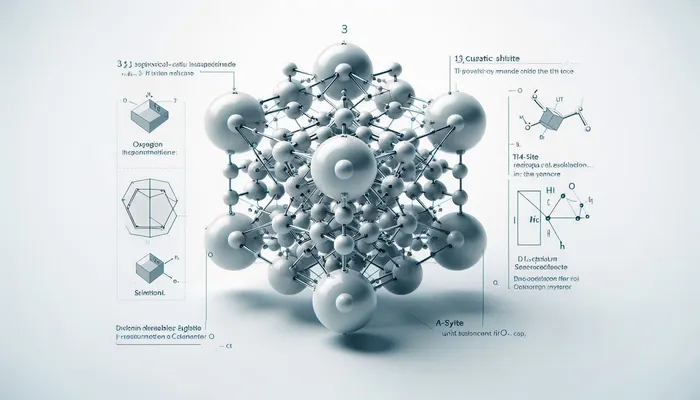
The most iconic class of ferroelectric materials is the perovskites, named after the mineral calcium titanate (CaTiO₃). A classic example is barium titanate (BaTiO₃).
Its formula is:
- A-site: a large ion like Ba²⁺
- B-site: a smaller ion like Ti⁴⁺
- O-site: oxygen ions (O²⁻) forming an octahedral cage
🔄 Temperature-Dependent Symmetry
- Above 120°C (Curie temperature): BaTiO₃ has a cubic structure — highly symmetric and non-polar.
- Below 120°C: It shifts to a tetragonal structure — the Ti⁴⁺ ion moves off-center within its oxygen cage.
This tiny shift creates a dipole moment:
Where:
- = effective charge
- = displacement vector
Since the direction of displacement (and hence polarization) can be reversed by an electric field, BaTiO₃ becomes a ferroelectric.
❓ Why Aren’t All Non-Centrosymmetric Materials Ferroelectric?
You might wonder — if lack of a center of symmetry is so important, shouldn’t all non-centrosymmetric crystals be ferroelectric?
The answer is no.
Some crystals, like quartz, are piezoelectric — they generate polarization under mechanical stress. Others are pyroelectric — they respond to temperature changes. But only materials that can switch their polarization direction under an electric field are truly ferroelectric.
This switchability is what defines ferroelectricity.
🔄 Spontaneous Symmetry Breaking
A key idea from physics is spontaneous symmetry breaking. Imagine a ball on top of a hill — it can roll in any direction, but once it does, symmetry is lost. Similarly, in ferroelectric materials, the crystal “chooses” a direction for polarization below a certain temperature.
This chosen direction remains — until we reverse it using an external electric field. That’s how ferroelectric memories store data!
🧠 Summary
- Ferroelectricity arises when a material has a non-centrosymmetric crystal structure that allows for spontaneous, switchable polarization.
- Symmetry breaking is essential — high symmetry prevents dipoles from forming.
- Perovskite structures, like in BaTiO₃, are classic examples where atomic displacements lead to ferroelectric behavior.
🔮 What’s Next?
In the next post, we’ll explore how this polarization behaves under an electric field. Get ready to learn about spontaneous polarization and hysteresis loops — the memory effect that gives ferroelectrics their name!
Share and Follow