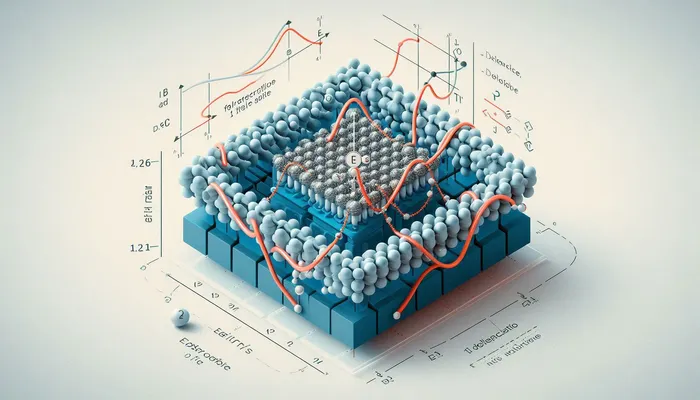
Ferroelectricity Series Overview
This series takes you through the fascinating science and applications of ferroelectric materials — from atomic-level mechanisms to real-world devices.
Previously on the Blog
In our last post, we explored how crystal symmetry and structure play a vital role in enabling ferroelectric behavior. We introduced perovskites and their structural transitions as a foundation.
What’s in This Post?
In this post, we dive into two core aspects of ferroelectricity: spontaneous polarization, the hallmark of these materials, and hysteresis, the nonlinear electric response that makes them both unique and useful.
🧲 What is Spontaneous Polarization?
In a ferroelectric material, the internal arrangement of ions leads to a permanent electric dipole — even without any external electric field. This is called spontaneous polarization.
📌 Key Points:
- It originates from displacement of atoms in a non-centrosymmetric unit cell.
- It exists naturally in the material below a certain temperature (Curie temperature).
- Unlike in a regular dielectric, this polarization does not need an external field to arise.
Let’s denote polarization as . In ferroelectrics, even at (no applied electric field), we have — this is the definition of spontaneous polarization.
⚛️ Microscopic Picture
Imagine a perovskite lattice like BaTiO₃. Below the Curie temperature:
- Ti⁴⁺ ion shifts away from the center of the O₆ octahedron.
- This causes a dipole moment in each unit cell.
- These moments align, leading to macroscopic polarization.
🔁 The Hysteresis Loop: Memory in Polarization
When an external electric field is applied to a ferroelectric material, the polarization doesn’t just increase linearly like in normal dielectrics.
Instead, it lags behind the applied field — a phenomenon known as hysteresis.
📈 Understanding the Hysteresis Curve
The typical P-E (polarization vs electric field) curve looks like a loop:
- Starting from zero field, the polarization begins to rise.
- At a certain point, the domains align completely: saturation polarization .
- When is reduced to zero, some polarization remains: remanent polarization .
- Reversing the field leads to coercive field , the point where net polarization becomes zero again.
This loop proves that ferroelectric materials remember their polarization state — which is why they’re useful for non-volatile memory.
📊 Physical Significance of Parameters
| Parameter | Symbol | Description |
|---|---|---|
| Spontaneous Polarization | Max polarization under strong field | |
| Remanent Polarization | Polarization at zero field | |
| Coercive Field | Field required to switch polarization |
Each of these plays a role in device performance, especially in memory applications.
🧠 Domain Switching: The Real Mechanism
Polarization changes are not due to individual dipoles rotating smoothly, but rather:
- Domain walls (boundaries between regions of different polarization) move.
- Under external field, favorable domains grow, unfavorable ones shrink.
- This movement causes the nonlinear, lagging response seen in hysteresis.
🌡️ Temperature Effects
Above the Curie temperature , the material becomes paraelectric:
- No spontaneous polarization
- No hysteresis loop
- Behavior resembles a regular dielectric
Below :
- Spontaneous polarization appears
- Hysteresis loop emerges
🧩 Conclusion
Spontaneous polarization and hysteresis are signature traits of ferroelectrics. They enable memory, sensing, and actuation capabilities far beyond traditional dielectrics. By understanding these phenomena, we get closer to unlocking the full potential of ferroelectric materials.
🧭 Up Next
In the next post, we will explore theoretical models like Landau theory, which describe the phase transitions and energy landscape of ferroelectrics.
Share and Follow if you’re enjoying this series!