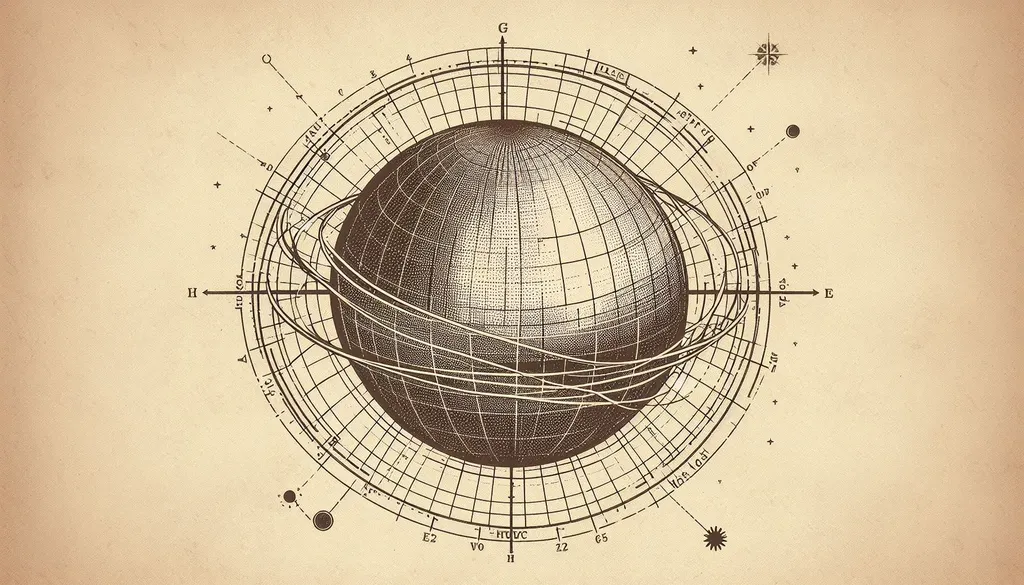
🧠 Overview
In Post 1, we explored why we needed General Relativity. Newton’s theory, while powerful, couldn’t explain key phenomena involving light, acceleration, and the flow of time. Einstein’s breakthrough was to see gravity not as a force, but as the result of curved space-time — a radical shift in how we understand motion, mass, and the universe itself.
Now in Post 2, we go deeper: What does it actually mean for space-time to curve? To answer that, we must first understand the geometry of space-time. This post introduces the foundational concepts behind General Relativity’s mathematics — from 4D space-time and coordinate systems to the nature of curvature itself.
By the end, you’ll see how gravity emerges naturally from geometry — not by pushing or pulling, but by shaping the paths that objects naturally follow.
📚 Table of Contents
- Spacetime as a 4D Continuum
- Coordinate Systems in Relativity
- What is Curvature? (Gaussian & Riemannian Intuition)
- Metric Tensor: Measuring in Curved Space
- Parallel Transport & Geodesics (Straight Lines in Curved Space)
- Curvature ≠ Force: Why Objects Fall
1. Spacetime as a 4D Continuum
In Newtonian physics, space and time are treated separately. Space has three dimensions — length, width, and height — while time flows independently in the background. But Einstein’s theory of relativity showed that this separation is artificial.
Instead, the universe is a four-dimensional continuum called spacetime, where:
- The first three dimensions are spatial: ( x, y, z )
- The fourth is temporal: ( t )
An event — like a lightning strike — isn’t just defined by where it happens, but also when. This leads to a unified coordinate system:
In relativity, space and time mix depending on the motion of the observer. A clock on a spaceship ticks differently than one on Earth. Distances contract. These effects aren’t optical illusions — they’re consequences of how spacetime behaves. Understanding this four-dimensional fabric is the first step to grasping curvature and gravity in Einstein’s framework.
2. Coordinate Systems in Relativity
In classical physics, coordinates are like a universal backdrop — one size fits all. But in General Relativity, space and time are dynamic and flexible, and so are the coordinates we use to describe them.
Why does this matter? Because:
- Spacetime is curved near massive objects.
- Different observers, moving differently or located in different gravitational fields, measure time and distance differently.
To stay consistent, the laws of physics must look the same in all coordinate systems — this is the principle of general covariance.
Examples of coordinate systems used in relativity:
- Minkowski coordinates: For flat spacetime in Special Relativity.
- Schwarzschild coordinates: For spacetime around a spherical mass like a planet or black hole.
- Rindler coordinates: For uniformly accelerated observers.
Relativity gives you freedom in your coordinate choices — but you must account for how they warp with the underlying geometry. That’s where tensors and the metric come into play.
3. What is Curvature? (Gaussian & Riemannian Intuition)
When we say “spacetime is curved,” we mean its geometry is non-Euclidean — it doesn’t follow the rules of flat space.
Start with Gaussian curvature, which applies to 2D surfaces:
- A flat plane has zero curvature.
- A sphere has positive curvature.
- A saddle shape has negative curvature.
A key test: draw a triangle on the surface. In flat space, angles sum to 180°. On a sphere, they add to more; on a saddle, less.
But spacetime is 4D — we need Riemannian geometry, developed by Bernhard Riemann. It generalizes curvature to higher dimensions using a mathematical object called the Riemann curvature tensor.
Curvature in General Relativity determines:
- How light bends near stars
- Why clocks tick slower in gravity
- How objects move without forces (following geodesics)
So, when Einstein said “mass curves spacetime,” he meant it quite literally — and Riemannian geometry gives us the tools to measure and describe that curvature.
4. Metric Tensor: Measuring in Curved Space
In General Relativity, space-time isn’t flat, and measuring distances or durations requires more than basic geometry. That’s where the metric tensor comes in — it’s like a ruler adapted for curved space-time.
In flat space (Euclidean), the distance between two points is:
In Special Relativity, space-time uses the Minkowski metric:
But in curved space-time, this becomes:
Where:
- is the interval (generalized distance),
- is the metric tensor, describing the curvature,
- and are differentials in space-time coordinates.
The metric tells you how lengths and times behave locally — including how clocks tick and how rulers stretch — depending on the curvature caused by mass and energy. Every solution in General Relativity (like black holes or expanding universes) comes with a specific metric.
5. Parallel Transport & Geodesics (Straight Lines in Curved Space)
In curved space-time, objects follow paths called geodesics — the closest analog to straight lines. But here’s the twist: in curved geometry, a “straight” path is the one that locally minimizes (or extremizes) the interval ( ds ).
So in the absence of forces, objects naturally follow geodesics — which look curved because the space-time itself is curved.
To understand this better, consider parallel transport:
- Move a vector (like velocity) along a surface while keeping its direction “constant”.
- On a sphere, you’ll find that after completing a loop, the vector’s direction changes — a sign of intrinsic curvature.
In relativity, free-falling objects (like planets or light beams) follow geodesics. They are not being pulled by gravity in the Newtonian sense — instead, they are obeying the geometry of space-time.
6. Curvature ≠ Force: Why Objects Fall
In Newton’s world, objects fall because gravity pulls them with a force:
In Einstein’s universe, falling is different. Imagine dropping a ball in empty space near Earth — it accelerates not because of a pull, but because it’s moving along a geodesic in a curved space-time shaped by Earth’s mass.
Gravity becomes an illusion of curvature:
- There’s no need for a force.
- Objects fall freely, following the “straightest” paths allowed by the geometry.
This view also explains:
- Why light bends near stars (its path curves in curved space).
- Why time slows in gravity (clocks tick differently in warped geometry).
- Why gravity affects everything, even massless particles like photons.
🧾 Conclusion
We’ve now crossed the threshold from “gravity as force” to “gravity as geometry.” Using tools like the metric tensor and geodesics, we can describe how mass and energy warp the fabric of space-time — and how that warp determines the paths of planets, photons, and even time itself.
This geometric view replaces Newton’s pull with elegant, curved motion — guided by the structure of the universe itself.
🧠 Up Next: Einstein’s Field Equations — Meaning and Motivation
You now understand what curvature is — but what creates it? How do we go from “here’s some mass” to “this is how space-time bends”?
In Post 3: Einstein’s Field Equations — Meaning and Motivation, we’ll:
- Compare Newton’s gravitational law with Einstein’s deeper equations
- Introduce the powerful and compact Einstein Field Equation (EFE):
- Break down what each term means
- Explore the stress-energy tensor, the real source of gravity
- And explain why these equations are beautiful… but notoriously hard to solve
Stay tuned as we dive into the core engine of General Relativity — where geometry and physics finally meet.