How We Detect Gravitational Waves: Listening to Ripples in Spacetime
In 2015, the universe whispered — and for the first time in human history, we heard it.
Gravitational waves, predicted over a century ago by Albert Einstein, were finally detected by scientists using an ultra-sensitive instrument called LIGO. But what exactly are these waves, and how do we detect something so faint it distorts space by less than a fraction of a proton?
Let’s break it down.
🌌 What Are Gravitational Waves?
Gravitational waves are ripples in spacetime caused by the acceleration of massive objects — like two black holes spiraling into each other or neutron stars colliding.
Einstein’s General Theory of Relativity predicted these waves in 1916. But because they are incredibly tiny, we couldn’t detect them for almost a century.
You can imagine them like ripples on a pond — only the pond is the fabric of the universe, and the ripples stretch and compress space itself.
🛠️ How Do We Detect Them?
Detecting gravitational waves isn’t about using telescopes or cameras. It’s about measuring how space stretches and shrinks using laser interferometry.
Enter LIGO and Virgo, the most sensitive rulers humanity has ever built.
🧪 LIGO (Laser Interferometer Gravitational-Wave Observatory)
LIGO has two giant detectors in the U.S. — one in Hanford, Washington, and one in Livingston, Louisiana.
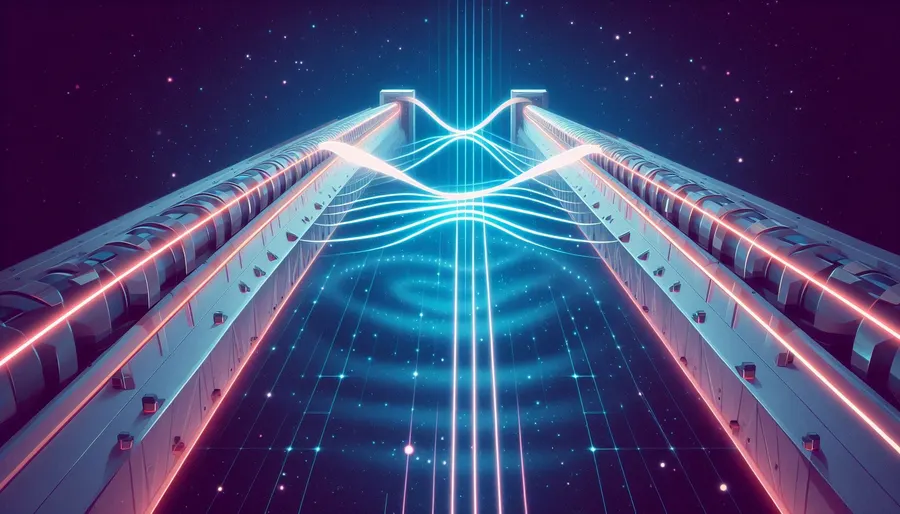
Each observatory has two arms arranged in an L-shape, 4 kilometers long each. Here’s how it works:
- A laser beam is split into two and sent down both arms.
- At the end of each arm, a mirror reflects the beam back.
- The two beams meet at a detector.
If spacetime is perfectly calm, the beams cancel each other out. But if a gravitational wave passes through:
- One arm stretches
- The other shrinks
- The light waves no longer cancel out
This change — as tiny as 1/10,000th the width of a proton — tells us a wave has passed.
📈 The Role of Interferometers
This setup is called a Michelson interferometer, a tool so sensitive it can measure a change in distance smaller than any human-made object.
Mathematically, gravitational wave strain is defined as:
Where:
- ( \Delta L ) is the change in arm length
- ( L ) is the original length (4 km for LIGO)
Typical detected strains are on the order of:
This means a 4-km arm changes length by just ( 4 \times 10^{-18} ) meters — much smaller than an atom!
🔭 Global Detection Network
Besides LIGO, several other detectors around the world help pinpoint gravitational wave sources:
- Virgo in Italy
- KAGRA in Japan
- LIGO-India (under development)
These observatories form a global gravitational wave network, allowing scientists to triangulate the origin of the waves in the sky.
🌌 What Have We Heard So Far?
Since 2015, scientists have detected dozens of gravitational wave events:
- Black hole mergers
- Neutron star collisions
- Black hole–neutron star combinations
The first ever detection, GW150914, came from two black holes merging over 1.3 billion light-years away.
Each detection gives us a new way to observe the universe — not with light, but with gravity itself.
🤯 Why Is This Revolutionary?
Detecting gravitational waves opened a new window into the cosmos:
- We can now “hear” events invisible to telescopes
- We test Einstein’s theory under extreme conditions
- We learn about the most violent events in space
This is the beginning of gravitational wave astronomy, and we’re just getting started.
🧠 Summary
- Gravitational waves are ripples in spacetime from massive cosmic collisions.
- LIGO and Virgo detect them using laser interferometry.
- These detectors measure changes smaller than an atom.
- We’ve already detected dozens of wave events — proving Einstein right once again.
🚀 The Future of Gravitational Wave Astronomy
Next-gen observatories like LISA (in space) and Einstein Telescope (underground in Europe) will help us detect:
- Supermassive black hole collisions
- Early universe gravitational signals
- Exotic objects like boson stars or cosmic strings
Soon, we won’t just look at the stars — we’ll listen to the entire universe.
“The universe is not silent. It has a soundtrack — and now we can hear it.”