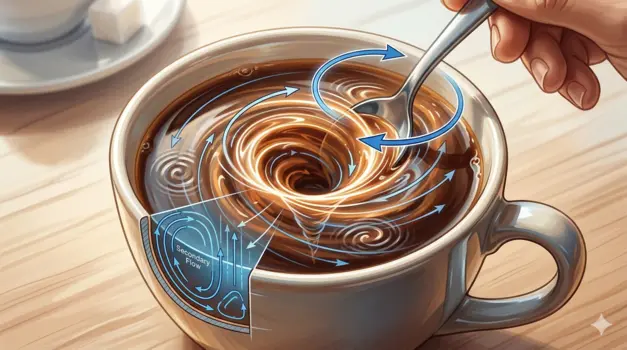
Have you ever stirred your morning coffee and noticed the beautiful swirling pattern that forms in your cup? That small, simple motion might seem ordinary, but it actually reveals fascinating ideas from physics.
The way coffee spins, slows down, and eventually settles involves important concepts like fluid dynamics, centrifugal force, and motion. These same principles are used by scientists to understand ocean currents, hurricanes, and even galaxies.
Physics isn’t just something that exists in textbooks or laboratories—it’s happening all around us every day. From the way liquids move in a cup to the way bicycles balance and airplanes fly, physical laws quietly shape the world we experience.
In this article, we’ll explore the physics behind why your coffee swirls, and then look at a few other everyday examples where physics is hiding in plain sight.
The Swirling Coffee Phenomenon
When you stir coffee with a spoon, you apply a force to the liquid. That force causes the coffee to start moving in a circular pattern inside the cup.
At first, the liquid spins quickly, creating a visible swirl. Over time, friction with the cup and the air gradually slows it down until the coffee becomes still again.
But during those few seconds of swirling motion, several interesting physics concepts are at work.
Fluid Dynamics: The Science of Moving Liquids
The motion of liquids and gases is studied in a branch of physics called fluid dynamics.
Fluids (like water, coffee, and air) behave differently from solid objects because they can flow and change shape.
When you stir coffee:
- The spoon pushes the liquid in a circular direction.
- The liquid near the spoon starts moving first.
- That movement spreads outward through the cup.
Because fluids interact with each other through friction and pressure, the entire cup of coffee eventually begins to rotate.
Why the Surface Forms a Curve
If you look closely at spinning coffee, you may notice that the center of the liquid dips slightly, forming a curved surface.
This happens because the spinning liquid is being pushed outward toward the walls of the cup.
Scientists call this effect a parabolic surface, and it’s commonly observed in rotating fluids.
Centrifugal Force in Your Coffee Cup
Another important concept in the swirling coffee example is centrifugal force.
Centrifugal force occurs when an object moving in a circular path experiences an outward push away from the center of rotation.
When your coffee spins:
- The liquid is pulled outward toward the cup’s edges.
- The center becomes slightly lower than the sides.
- Particles in the liquid move along curved paths.
You can observe a similar effect when:
- Water spins inside a washing machine
- A bucket of water is swung in a circle
- Amusement park rides spin rapidly
In all these cases, the outward push is caused by circular motion.
Why the Coffee Eventually Stops
If nothing interfered with the motion, the coffee might keep spinning forever. But in reality, it slows down quickly.
This happens because of friction.
Friction occurs between:
- The coffee and the cup’s surface
- Layers of liquid rubbing against each other
- The liquid and the surrounding air
These resistive forces gradually remove energy from the motion, causing the swirl to fade away.
This process illustrates an important physics idea called energy dissipation, where moving systems lose energy over time.
Everyday Physics Example 1: Why a Bicycle Stays Balanced
Riding a bicycle may feel simple, but it actually involves complex physics.
A moving bicycle stays balanced because of angular momentum and gyroscopic effects.
When the wheels spin:
- They create rotational stability.
- The spinning motion helps keep the bicycle upright.
This is similar to how a spinning top remains stable while rotating.
As long as the wheels are turning, the bike naturally resists tipping over.
That’s why balancing a bicycle becomes easier when you are moving faster.
Everyday Physics Example 2: Why Shower Curtains Move Toward You
Have you ever noticed a shower curtain slowly moving inward while you take a hot shower?
This surprising behavior can also be explained using fluid dynamics.
When hot water runs, it creates rising warm air and moving water droplets. These movements create differences in air pressure inside the shower.
Lower pressure inside the shower pulls the curtain inward.
This phenomenon is related to the Bernoulli principle, which states that faster-moving fluids create lower pressure.
The same principle helps explain how airplanes generate lift with their wings.
Everyday Physics Example 3: Why Ice Skaters Spin Faster When They Pull Their Arms In
Figure skaters perform impressive spins that demonstrate another important physics concept: conservation of angular momentum.
When a skater begins spinning:
- Their arms are extended outward.
- This spreads their mass over a larger area.
When they pull their arms inward:
- Their mass moves closer to the center.
- Their rotation speed increases dramatically.
This happens because angular momentum must remain constant.
As the radius decreases, the rotational speed increases.
The same principle explains how:
- Planets orbit stars
- Spinning stars collapse into neutron stars
- Divers spin faster during flips
Why Physics in Daily Life Matters
Many people think physics is only useful for scientists and engineers, but in reality, it shapes almost every part of our daily experience.
Understanding simple examples—like swirling coffee—helps us see that physics is not abstract or distant.
It explains:
- How liquids move
- How objects stay balanced
- How forces interact
- How motion changes over time
Recognizing these patterns makes the world more interesting and helps develop scientific thinking.
Next time you stir your coffee, take a moment to watch the swirling motion in your cup. What seems like a simple morning routine is actually a beautiful demonstration of physics in action.
The spinning liquid reveals principles of fluid dynamics, centrifugal force, and motion, showing how forces and energy shape the behavior of fluids. Similar physics concepts appear in many everyday situations—from riding bicycles to spinning figure skaters and even the movement of shower curtains.
By observing small details in daily life, we can uncover the hidden science behind the world around us. Physics isn’t just about equations and experiments—it’s a powerful way of understanding the ordinary moments we experience every day.