Quantum mechanics is one of the most fascinating and mind-bending areas of modern physics. It explains how the tiniest particles in the universe—like electrons and photons—behave in ways that seem almost magical compared to our everyday experience.
In our daily lives, objects behave in predictable ways. A ball rolls where you push it. A light switch is either on or off. But at the microscopic level, nature plays by very different rules. Particles can exist in multiple states at the same time, influence each other instantly across huge distances, and behave both like particles and waves.
These strange ideas form the core of quantum mechanics, a field that has revolutionized science and technology. Concepts like superposition and entanglement are not just theoretical curiosities—they power technologies such as lasers, MRI machines, semiconductors, and emerging quantum computers.
In this beginner-friendly guide, we will explore these ideas step by step using simple language, relatable analogies, and famous experiments that reveal the mysterious nature of the quantum world.
What is Quantum Mechanics?
Quantum mechanics is the branch of physics that studies the behavior of matter and energy at extremely small scales—typically atoms, electrons, and photons.
Classical physics, which describes things like planets, cars, and falling apples, works very well at large scales. However, when scientists began studying atoms in the early 20th century, they discovered that classical physics could not explain what they observed.
Instead, particles seemed to follow strange rules:
- They could behave like waves and particles.
- Their exact position could not always be predicted.
- Observing them could actually change their behavior.
This led to the development of quantum mechanics by scientists like Max Planck, Albert Einstein, Niels Bohr, and Erwin Schrödinger.
Today, quantum mechanics is one of the most successful scientific theories ever created. It accurately predicts the behavior of atoms, molecules, and subatomic particles.
The Double-Slit Experiment: Where Quantum Weirdness Begins
One of the most famous experiments in physics is the double-slit experiment, which demonstrates how particles behave like waves.
The Setup
Imagine a wall with two narrow openings (slits) and a screen behind it.
A beam of light or electrons is fired toward the slits.
If particles behaved like tiny bullets, you would expect two bright lines on the screen corresponding to the two slits.
But something surprising happens.
The Result
Instead of two lines, scientists observe a wave interference pattern—a series of bright and dark bands.
This pattern only appears when waves overlap and interfere with each other.
This means the particles somehow pass through both slits at the same time, behaving like waves.
Even Stranger
When scientists try to measure which slit the particle actually goes through, the interference pattern disappears.
The particle suddenly behaves like a normal particle again.
This experiment shows that observation itself affects quantum systems, a key idea in quantum mechanics.
Understanding Superposition
One of the most important principles of quantum mechanics is superposition.
What is Superposition?
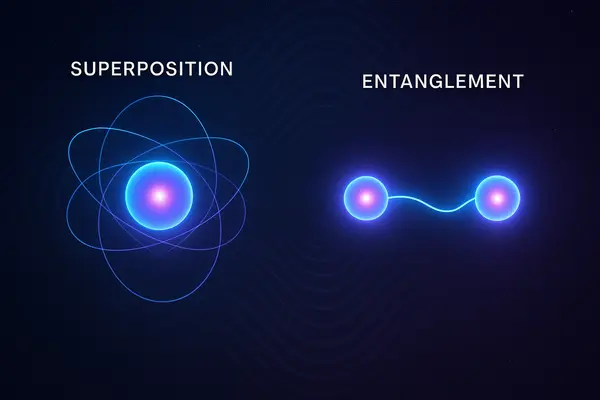
Superposition means that a quantum particle can exist in multiple states at the same time until it is measured.
For example:
An electron can be in multiple positions simultaneously.
A photon can take multiple paths at once.
Only when we observe the particle does it “choose” a single state.
Simple Analogy: A Spinning Coin
Imagine flipping a coin.
When the coin lands, it is either heads or tails.
But while the coin is spinning in the air, it is both heads and tails at the same time.
This is similar to superposition.
A quantum particle exists in many possible states simultaneously until a measurement forces it into one outcome.
Schrödinger’s Cat Thought Experiment
Physicist Erwin Schrödinger proposed a famous thought experiment to illustrate superposition.
A cat is placed in a sealed box with a device triggered by a quantum event.
Until the box is opened, quantum theory suggests the cat is both:
- Alive
- Dead
at the same time.
Of course, this example is meant to highlight how strange quantum mechanics can seem when applied to everyday objects.
What is Quantum Entanglement?
Another remarkable phenomenon in quantum mechanics is entanglement.
The Basic Idea
When two particles become entangled, their properties become linked.
Even if the particles are separated by huge distances, measuring one particle instantly determines the state of the other.
Albert Einstein famously called this:
“Spooky action at a distance.”
Simple Analogy: Magic Gloves
Imagine you have two gloves:
- One left glove
- One right glove
You place them in separate boxes and send one box to the Moon.
When someone opens the box on Earth and finds the left glove, they instantly know the glove on the Moon must be right.
Entanglement works similarly, but with an important difference:
Before measurement, the particles do not have fixed states yet.
Their states only become determined when one is observed.
Real Experiments Proving Entanglement
Quantum entanglement is not just theory—it has been tested many times.
One famous test involves Bell’s Theorem, proposed by physicist John Bell.
Experiments performed over the past decades confirmed that entangled particles show correlations that cannot be explained by classical physics.
In 2022, the Nobel Prize in Physics was awarded to scientists who performed groundbreaking experiments confirming quantum entanglement.
These experiments demonstrated that quantum mechanics truly describes how nature works at fundamental levels.
Real-World Technologies Based on Quantum Mechanics
Quantum mechanics might seem abstract, but it already powers many technologies we use every day.
1. Semiconductors and Computers
Modern computers rely on transistors, which work because of quantum behavior in semiconductors.
Without quantum mechanics, smartphones and laptops would not exist.
2. Lasers
Lasers rely on quantum energy transitions in atoms.
They are used in:
- Fiber-optic communication
- Medical surgery
- Barcode scanners
- Blu-ray players
3. MRI Scanners
Medical imaging techniques like MRI depend on quantum properties of atomic nuclei.
These machines help doctors see inside the human body safely.
4. Quantum Computing (Emerging Technology)
Quantum computers use qubits, which rely on superposition and entanglement.
Unlike classical bits that are either 0 or 1, qubits can be both at the same time.
This could allow quantum computers to solve certain problems far faster than traditional computers.
5. Quantum Cryptography
Entanglement also enables extremely secure communication systems.
If someone tries to intercept a quantum message, the act of measurement reveals the intrusion.
Why Quantum Mechanics Feels So Strange
Quantum mechanics challenges our everyday intuition because the human brain evolved to understand the macroscopic world, not atomic scales.
At extremely small sizes:
- Probability replaces certainty
- Particles behave like waves
- Observation affects outcomes
Despite its strange nature, quantum mechanics has passed every experimental test scientists have thrown at it.
Many physicists believe that the universe itself is fundamentally quantum.
The world of quantum mechanics shows us that reality is far more mysterious than we once believed. Concepts like superposition and entanglement reveal that particles can exist in multiple states simultaneously and influence each other across vast distances in ways that defy classical intuition.
Experiments like the double-slit experiment demonstrate that observation itself plays a role in determining physical outcomes. These discoveries forced scientists to rethink the nature of matter, energy, and information.
Today, quantum mechanics is not just a theoretical curiosity—it is the foundation of modern technology and the key to future breakthroughs such as quantum computing, quantum communication, and potentially new forms of energy and materials.
Understanding these ideas helps us appreciate how the universe works at its deepest level. The quantum world may seem strange, but it is also incredibly beautiful, revealing that reality is richer, more complex, and more fascinating than our everyday experiences suggest.