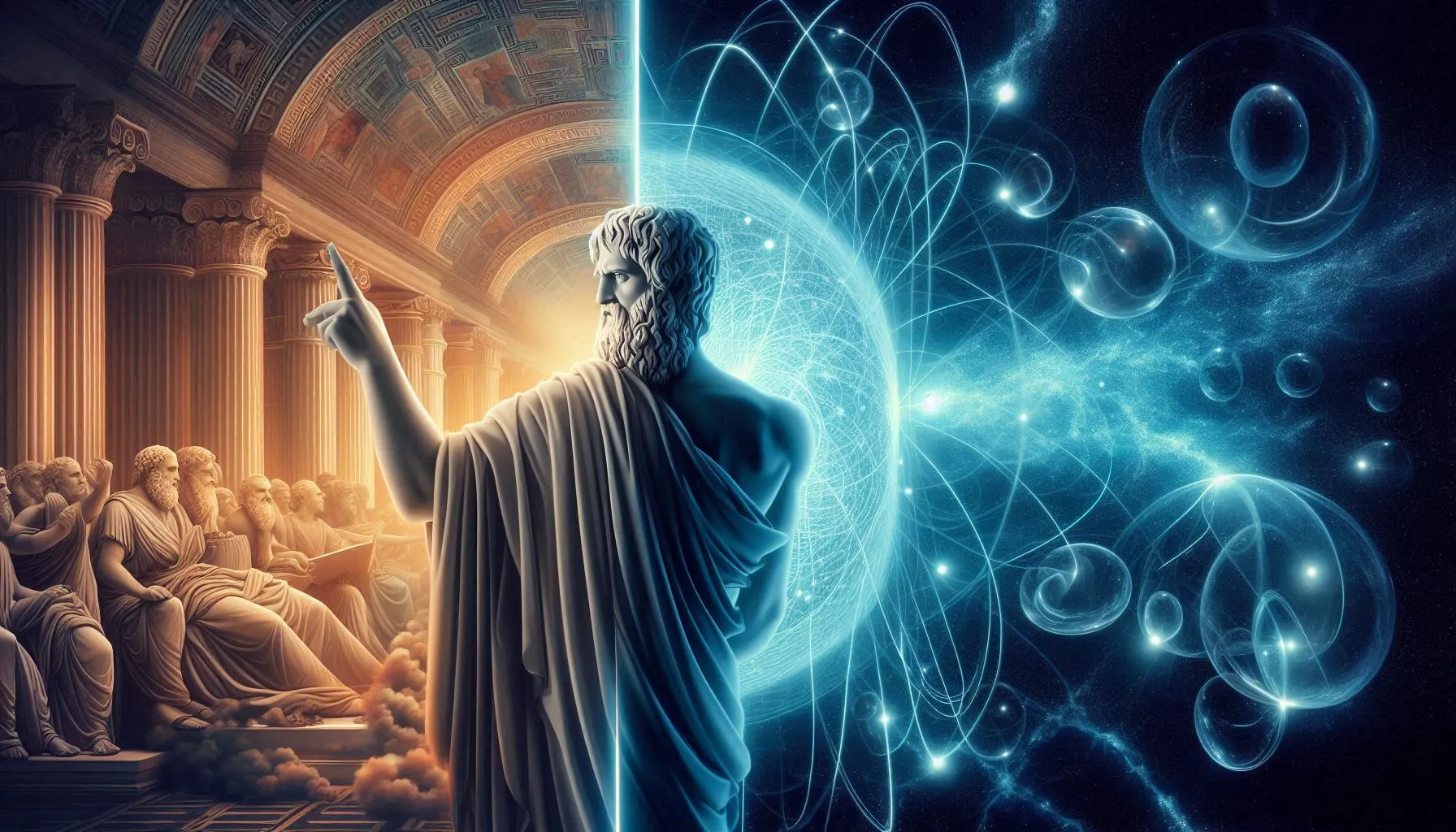
🌌 What Is a Vacuum? From Aristotle to Quantum Fields
🧠 Overview
The idea of a vacuum—a space completely devoid of matter—has fascinated thinkers for centuries. From Aristotle’s outright rejection of the void to the dynamic quantum fields of modern physics, our understanding of “nothingness” has undergone a radical transformation. In this journey through time, we explore how the vacuum shifted from an abstract philosophical debate to a central concept in quantum field theory (QFT), brimming with virtual particles, zero-point energy, and spacetime fluctuations.
🏛️ Aristotle to Newton: The Historical Vacuum
- Aristotle (4th century BCE) argued that nature abhors a vacuum (“horror vacui”), believing that all space must be filled with some substance.
- Democritus and Leucippus, earlier Greek atomists, thought a vacuum was necessary for atoms to move—an idea mostly ignored for centuries.
- Isaac Newton (17th century) accepted the concept of a vacuum, positing that forces like gravity could act across empty space.
- By the 19th century, physicists imagined a vacuum as space cleared of matter, yet filled with the luminiferous aether, a hypothetical medium for light waves.
🧬 From Empty Space to Fields
The rise of Einstein’s theory of relativity and Maxwell’s electromagnetic theory marked the beginning of a shift:
- The idea of a classical vacuum as an empty void became outdated.
- Fields—like the electromagnetic field—were understood to exist independently of particles.
- Even in “empty” space, electric and magnetic field potentials could exist.
This prepared the groundwork for the field-based approach of quantum mechanics.
🌀 The Quantum Vacuum: Stillness with Ripples
In quantum field theory, a vacuum isn’t truly empty. It’s the lowest energy state of a quantum field, but not devoid of activity.
🔁 Analogy:
Imagine a perfectly calm ocean surface—no boats, no waves. But zoom in, and you’ll see tiny ripples, constantly forming and vanishing.
This is the quantum vacuum: calm on average, yet alive with fleeting fluctuations.
✨ Virtual Particles and Zero-Point Energy
Thanks to the Heisenberg Uncertainty Principle, even the vacuum state can have fluctuations in energy and time:
ΔE·Δt ≥ ℏ⁄2
- These fluctuations lead to the emergence of virtual particles—particle-antiparticle pairs that briefly exist before annihilating.
- They’re invisible but produce measurable effects like the Casimir effect and Lamb shift.
- The vacuum possesses zero-point energy, meaning it still holds energy even when all classical movement stops.
🌌 Modern Implications of the Vacuum
The quantum vacuum plays a fundamental role in modern physics:
- It contributes to the cosmological constant, potentially explaining the acceleration of the universe.
- It seeds quantum fluctuations in the early universe, which evolve into galaxies and cosmic structures.
- It’s central to Hawking radiation, where black holes emit particles due to quantum effects near their horizons.
📘 Click to Show Simple Mathematical Expressions
Key Equations:
-
Uncertainty Principle (Time-Energy):
ΔE · Δt ≥ ℏ / 2
-
Zero-point energy of a harmonic oscillator:
E₀ = ½ ℏ ω -
Vacuum state correlation in field theory:
⟨0 | φ(x) φ(y) | 0⟩ ≠ 0Indicates that fluctuations correlate even in the vacuum state.
🧠 Interpretations & Implications
From a philosophical question to a physical foundation, the vacuum has evolved:
- What we once saw as empty is now a foamy sea of energy.
- Every point in space holds latent potential, embedded in quantum fields.
- Understanding the vacuum is key to unifying physics, from quantum mechanics to cosmology.
🧾 Conclusion
The vacuum is no longer “nothing.” It is the backdrop of reality, woven from fields that ripple with energy and virtual particles. From Aristotle’s denial to the depths of quantum theory, the vacuum has proven to be everything but empty.