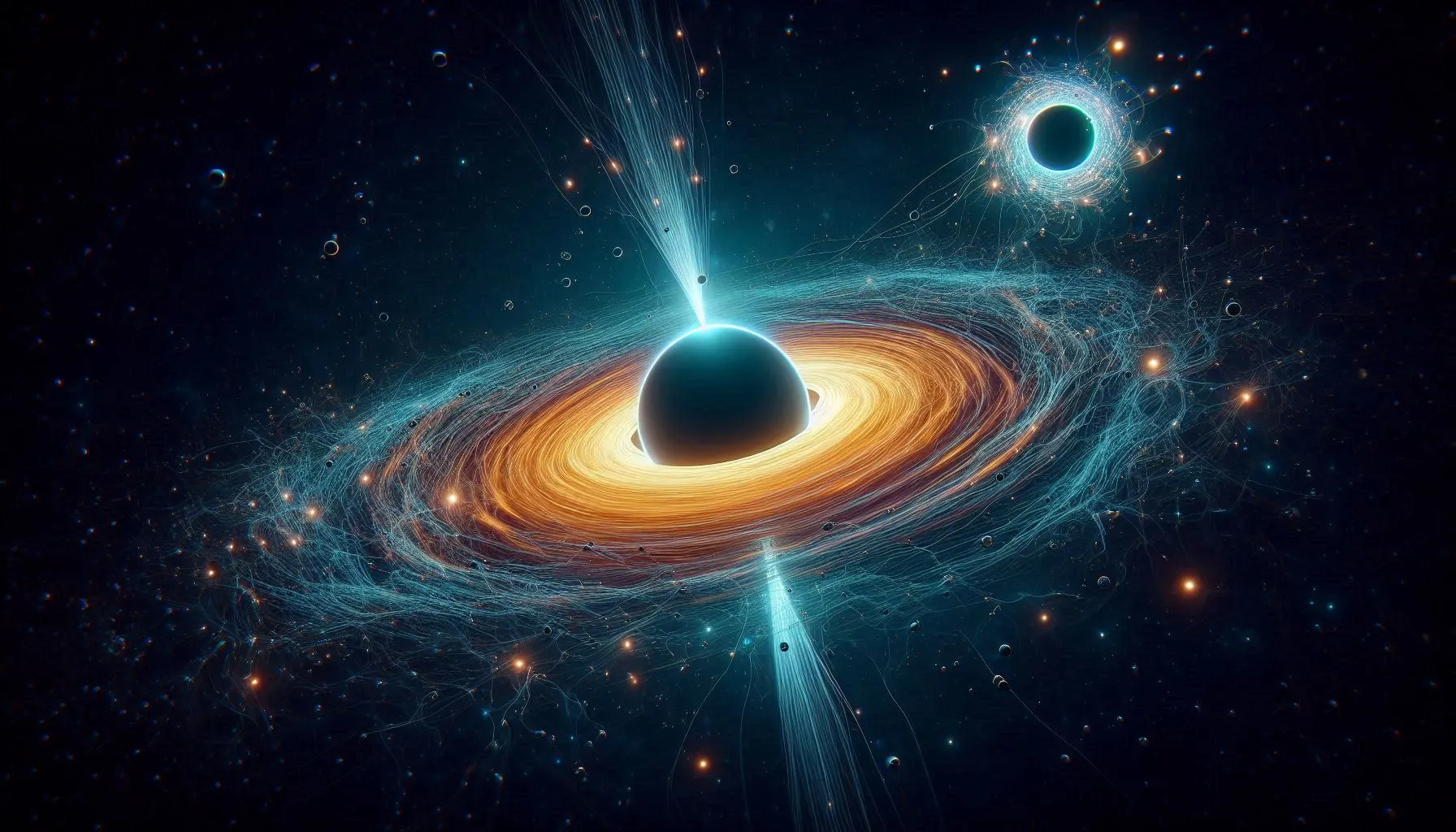
🕳️ When Black Holes Leak: Hawking Radiation & the Vacuum
🧠 Overview
Black holes are famously known for trapping everything—even light. But in a stunning twist, Stephen Hawking showed in 1974 that black holes can emit radiation and slowly evaporate over time. This revelation didn’t come from gravity alone—it emerged from the quantum vacuum at the event horizon. Hawking radiation is one of the most mind-bending predictions in physics, uniting quantum mechanics, thermodynamics, and general relativity.
🌌 The Event Horizon and the Quantum Vacuum
At the boundary of a black hole—the event horizon—gravity is so intense that escape becomes impossible. But the vacuum of space is not silent.
According to quantum field theory, the vacuum is constantly bubbling with virtual particle–antiparticle pairs. Normally, these pairs appear and annihilate within tiny fractions of a second. But near a black hole’s horizon:
- One particle can fall in.
- The other can escape as real radiation.
This process extracts energy from the black hole itself.
🌠 How Hawking Radiation Emerges
Here’s how it works in steps:
- Virtual pair creation: A particle and its antiparticle briefly appear from vacuum fluctuations.
- Separation by the event horizon: One particle falls into the black hole; the other escapes to infinity.
- Energy balance: The particle that escapes becomes real, while the infalling partner has negative energy (relative to the outside).
- Result: The black hole loses mass over time — it radiates!
This radiation is thermal and follows the laws of black body radiation — the smaller the black hole, the hotter it gets.
♨️ Link to Thermodynamics: Black Hole Entropy
Before Hawking’s insight, black holes seemed to violate thermodynamics — they had no temperature or entropy.
Hawking’s result changed that:
-
Black holes have entropy proportional to their horizon area:
-
They emit radiation at a temperature inversely related to their mass:
This revealed that black holes behave like thermodynamic objects, obeying laws analogous to heat and energy flow.
🧩 A Teaser: The Information Paradox
If a black hole evaporates and disappears… what happens to the information about everything it swallowed?
- Classical theory says it’s lost forever.
- Quantum mechanics says information must be preserved.
This conflict is known as the black hole information paradox — one of the biggest puzzles in modern physics, inspiring theories from firewalls to holography.
We’ll explore this mystery in future posts.
📘 Click to Show Core Equations
Key Equations:
-
Hawking Temperature:
-
Black Hole Entropy (Bekenstein–Hawking formula):
-
Power of Hawking Radiation (for a non-rotating black hole):
🧠 Interpretations & Implications
Hawking radiation shows that:
- Black holes aren’t eternal—they slowly lose mass.
- The vacuum isn’t empty—it fuels radiation.
- Quantum mechanics and gravity must be reconciled in a deeper theory, possibly quantum gravity or string theory.
This phenomenon also leads to new thinking in cosmology, quantum information, and the fate of the universe itself.
🧾 Conclusion
Hawking radiation turns our view of black holes upside-down. What once seemed like perfect absorbers are now slow emitters, powered by the jitter of the quantum vacuum. They leak not just energy—but potentially the keys to unifying physics.