🧠 Overview
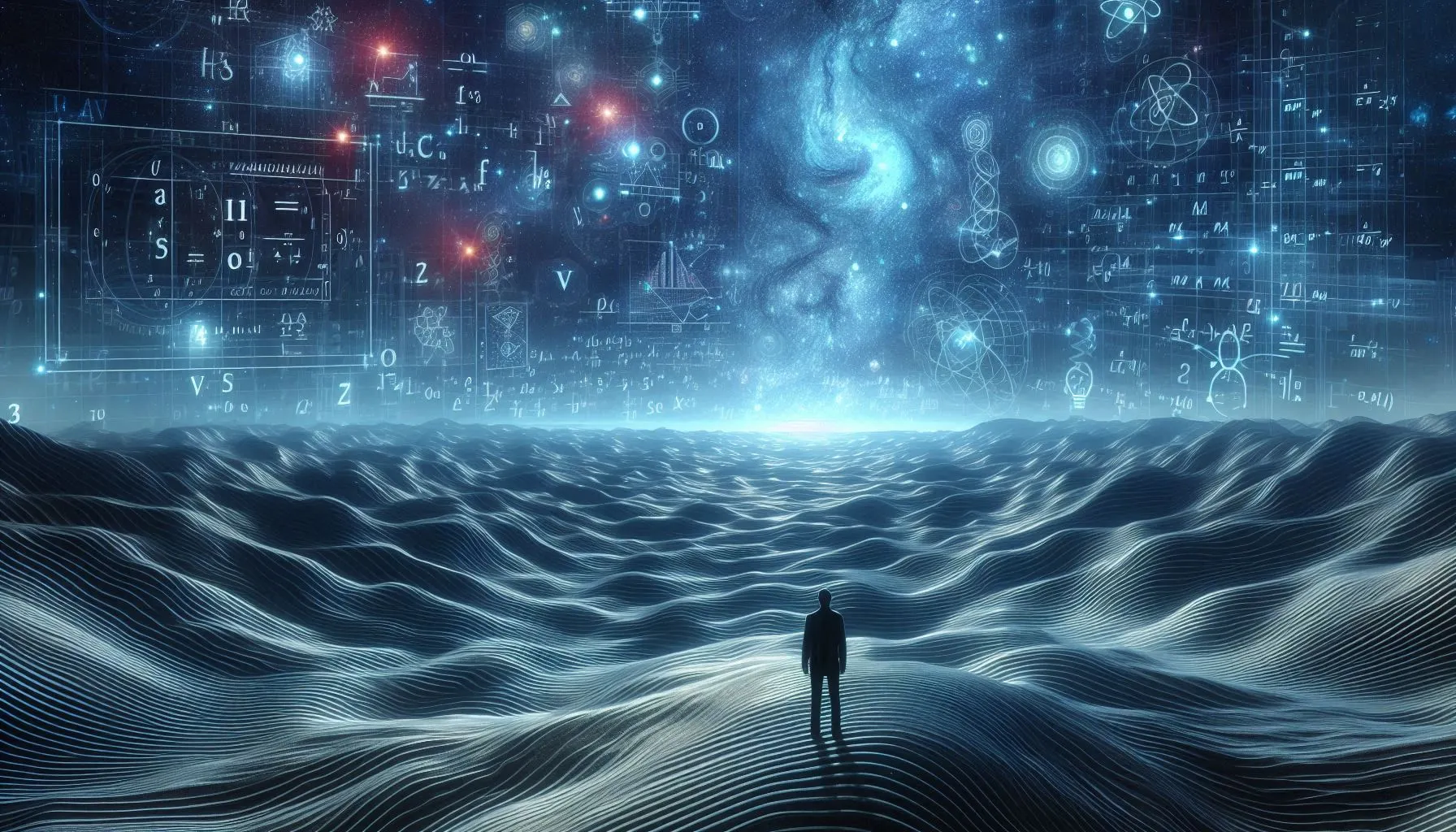
If there is one concept poised to revolutionize our understanding of the universe, it’s not a particle or a force — it’s the quantum vacuum. Far from being empty, the vacuum is a deeply structured arena where space, time, and energy coalesce into a dynamic system teeming with invisible activity.
From the expansion of the universe to the birth of particles, from black hole evaporation to laboratory quantum experiments, the quantum vacuum increasingly appears not just as a backdrop to physics — but its very foundation. As physicists push toward a “Theory of Everything”, the quantum vacuum is emerging as the central player.
🧪 A Recap: Discoveries That Anchor the Vacuum in Physics
1. Casimir Effect
In 1948, Hendrik Casimir predicted that two neutral metal plates placed a few micrometers apart in vacuum would attract — not due to any field or particle, but due to vacuum fluctuations. This effect has since been experimentally verified, showing the vacuum has measurable physical effects.
2. Hawking Radiation
Stephen Hawking’s 1974 insight showed that black holes are not entirely black — they emit radiation due to quantum effects at the event horizon, where virtual particles in the vacuum can become real. This suggests the vacuum interacts with gravity in complex ways.
3. Inflation and Dark Energy
The early universe underwent exponential expansion driven by a hypothesized vacuum-like scalar field, and today, the accelerating expansion of the cosmos is attributed to vacuum energy — the cosmological constant. In both cases, vacuum plays a cosmic role.
4. Quantum Electrodynamics (QED)
In quantum field theory, the vacuum state determines how particles propagate and interact. Virtual particles and vacuum polarization are crucial for the most accurate predictions in physics (e.g., the anomalous magnetic moment of the electron).
🔬 Ongoing Research: The Vacuum as a Laboratory and Lattice
🌀 1. Quantum Gravity and the Emergent Vacuum
Many leading theories of quantum gravity — including loop quantum gravity, causal set theory, and asymptotic safety — suggest that spacetime and vacuum are emergent, not fundamental.
- Spacetime as a condensate: Some models treat spacetime as a quantum fluid.
- Granular vacuum: Loop quantum gravity predicts quantized spacetime areas and volumes.
🧵 2. String Theory and the Vacuum Landscape
String theory postulates that our universe is one possible vacuum state among (10^{500}) in the “string landscape.”
- Vacuum selection problem: Why does our universe occupy this specific vacuum?
- Flux compactifications: These define many metastable vacua with different constants.
🧫 3. Laboratory-Created Vacuums and Quantum Simulation
Advancements allow physicists to recreate vacuum-like environments:
- Analog gravity: Simulate black holes with Bose-Einstein condensates.
- Vacuum birefringence: Observe light distortion in strong magnetic vacuums.
- Dynamical Casimir effect: Detect photons from accelerated boundaries in vacuum.
🧠 Philosophical and Foundational Questions
Can Something Come from Nothing?
Inflationary cosmology proposes that the entire universe emerged from vacuum fluctuations.
- Is the vacuum truly “nothing,” or a hidden medium?
- Are the laws of physics emergent from vacuum structure?
- Does the vacuum encode all possible realities?
Vacuum and the Arrow of Time
Although vacuum appears time-symmetric in quantum theory, its role in cosmic expansion suggests a possible link to the arrow of time and entropy flow.
🧭 Final Thoughts: The Vacuum as the Next Scientific Paradigm
We often search for truth in matter, forces, or symmetries, but the most universal element may be the absence of everything — the vacuum. It is the:
- Birthplace of particles
- Engine of cosmic expansion
- Bridge between quantum theory and gravity
- Mirror of metaphysical reality
To understand the vacuum is to probe the origin of structure, time, and causality. Physics is entering a new era — one grounded not in stuff, but in the dynamics of empty space itself.
📚 Further Reading & Exploration
- The Inflationary Universe by Alan Guth
- QED: The Strange Theory of Light and Matter by Richard Feynman
- The Road to Reality by Roger Penrose
- Many Worlds in One by Alex Vilenkin
For academic deep dives, explore SciSpace — your companion for reading, analyzing, and understanding scientific literature.
🧾 Conclusion
The quantum vacuum is no longer the absence of existence — it is its deepest expression. In it lie the seeds of spacetime, the mystery of existence, and the promise of unification. As the frontier between quantum theory, gravity, and cosmology converges, the vacuum may hold the final answers — or at least the right questions.