🔁 Previous Post Recap
In Part 7, we explored the Ginzburg–Landau theory, a macroscopic quantum model that introduced the order parameter and unified our understanding of superconductivity at the thermodynamic and electromagnetic levels.
But GL theory is still phenomenological. It doesn’t explain why superconductivity occurs at the microscopic quantum level.
To truly understand superconductivity, we must dig deeper into the quantum realm.
⚛️ The Breakthrough: BCS Theory
The BCS theory, proposed in 1957 by John Bardeen, Leon Cooper, and Robert Schrieffer, provided the first microscopic explanation of superconductivity.
For this work, the trio won the 1972 Nobel Prize in Physics.
At its heart lies a surprising idea:
Electrons, which normally repel each other, can pair up under the right conditions — and this pairing leads to superconductivity.
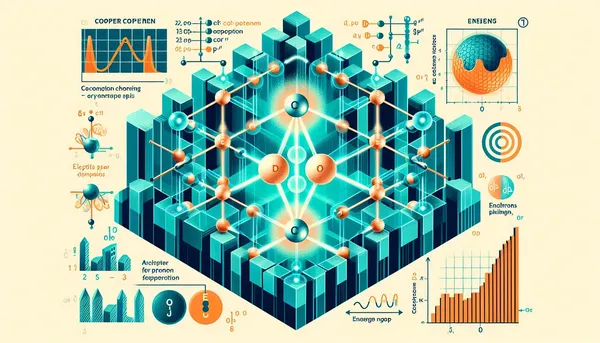
🧲 Cooper Pairs: Electrons That Stick Together
In a normal metal, electrons scatter off the vibrating ions in the lattice, causing resistance.
But in a superconductor, an attractive interaction emerges — not directly between electrons, but mediated by lattice vibrations, or phonons.
🧪 How It Works:
- An electron moving through the crystal slightly distorts the lattice, attracting nearby positively charged ions.
- This distortion creates a local potential well.
- Another electron with opposite momentum and spin is attracted to this well — effectively forming a bound pair.
These paired electrons are called Cooper pairs.
⚙️ Key Features:
- Cooper pairs behave as bosons, allowing them to occupy the same quantum state.
- They do not scatter individually, but move coherently as a macroscopic quantum state.
- This leads to zero electrical resistance and the Meissner effect.
📉 Energy Gap: The Superconducting Signature
In BCS theory, the formation of Cooper pairs creates a gap in the energy spectrum around the Fermi level:
Where:
- is the energy gap at temperature
- is the gap at absolute zero
- is the critical temperature
This gap means:
- A finite amount of energy is needed to break a Cooper pair
- Thermal excitations can’t scatter electrons easily
- The material remains in a stable superconducting state
🧠 The BCS Ground State
The BCS ground state is a quantum superposition of many-pair states, described by:
Here:
- creates an electron of momentum and spin
- and are probability amplitudes
This ground state has long-range phase coherence — all Cooper pairs are entangled in one macroscopic quantum state.
🔬 Predictions and Experimental Confirmation
BCS theory makes several predictions that match real-world observations:
| Prediction | Observation |
|---|---|
| Existence of an energy gap | Confirmed by tunneling and ARPES |
| Specific heat jump at | Matches experimental data |
| Meissner effect | Consistent with zero magnetic field inside |
| Isotope effect (Tc ∝ M^(-1/2)) | Observed in classic superconductors |
| Critical current behavior | Matches GL and London predictions |
📚 Strengths and Limitations
✅ Strengths:
- Accurately explains low-temperature superconductors
- Quantitative agreement with numerous experiments
- Provides deep insight into quantum states of matter
⚠️ Limitations:
- Doesn’t explain high-temperature superconductivity in cuprates
- Assumes weak coupling and phonon-mediated pairing
- Not suitable for materials with strong electron correlations
These limitations led to the search for alternative theories for more complex materials.
💡 Intuitive Analogy
Imagine a crowded dance floor. Electrons, like dancers, constantly bump into each other (scattering). But under special lighting and music (low temperatures and phonon interactions), dancers form synchronized pairs, moving in harmony without colliding.
That’s superconductivity — a quantum dance of paired particles.
🧾 Conclusion
The BCS theory is a monumental leap in our understanding of quantum matter. By revealing how microscopic electron pairs can form a macroscopic quantum state, it laid the foundation for superconducting technologies and quantum physics as we know it.
🔮 Coming Up Next…
In Part 9, we’ll explore the quantum effects that arise in superconductors — including flux quantization, the Josephson effect, and how SQUIDs use interference for ultra-sensitive measurements.
Stay curious — the quantum world is about to get weirder.