🔁 Previously in This Series (Part 11)
In Part 11, we explored the experimental techniques used to study superconductivity — from resistivity and magnetization to advanced tools like STM, ARPES, and muon spin rotation. These methods allow us to probe the quantum nature of superconductors from atomic to macroscopic scales.
🧪 From Theories to Materials: The Stars of Superconductivity
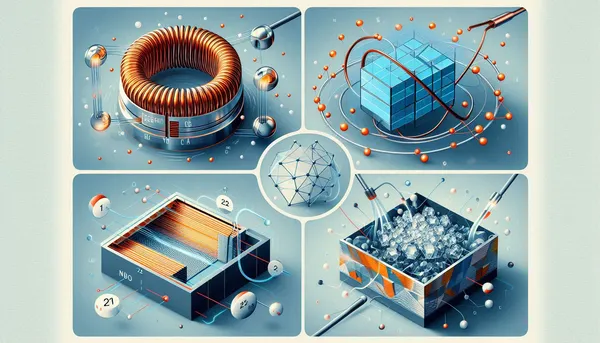
The power of superconductivity doesn’t come just from the equations or theories—it lies in the materials that actually exhibit these exotic properties. In this post, we’ll examine four landmark superconductors, each with unique characteristics and real-world importance:
- Niobium-Titanium (NbTi)
- Yttrium Barium Copper Oxide (YBCO)
- Bismuth Strontium Calcium Copper Oxide (Bi-2212)
- Magnesium Diboride (MgB₂)
We’ll explore their structure, critical parameters, and applications.
🧰 1. Niobium-Titanium (NbTi)
Type: Type II, conventional (BCS)
Discovered: 1960s
Critical Temperature (): ~9.2 K
Critical Field: ~15 T
Use Case: MRI magnets, particle accelerators, fusion reactors (e.g., ITER)
Overview:
NbTi is one of the most widely used low-temperature superconductors (LTS) in the world. It is ductile, easy to fabricate into wires and cables, and operates reliably in high magnetic fields when cooled by liquid helium.
Its combination of moderate and high critical current density makes it ideal for industrial superconducting magnets.
🔷 2. Yttrium Barium Copper Oxide (YBCO)
Chemical Formula: YBa₂Cu₃O₇₋δ
Type: Type II, high-temperature
Discovered: 1987
Critical Temperature (): ~92 K
Structure: Layered perovskite with CuO₂ planes
Use Case: Maglev trains, superconducting cables, HTS transformers
Overview:
YBCO was the first high-temperature superconductor to operate above liquid nitrogen temperature, revolutionizing possibilities for superconducting technologies.
Its strong flux pinning, high , and chemical stability make it suitable for coated conductor wires used in superconducting tapes and rotating machinery.
Challenges include grain boundary sensitivity and fabrication cost, but ongoing advances in thin-film deposition and buffer layer engineering are addressing these.
🧱 3. Bismuth-Based Superconductors (Bi-2212)
Chemical Formula: Bi₂Sr₂CaCu₂O₈₊x
Discovered: Late 1980s
Critical Temperature (): ~85–95 K
Structure: Highly anisotropic, with double CuO₂ layers
Use Case: Superconducting wires in high-field magnets
Overview:
Bi-2212 is one of the most promising HTS materials for wire production. It can be fabricated into round wires, unlike many other brittle cuprates, and used in solenoids for powerful magnetic fields exceeding 25 T.
It exhibits significant anisotropy, and requires high-temperature oxygen annealing during processing. Still, it is leading the way in applications where compact, high-field magnets are essential.
✴️ 4. Magnesium Diboride (MgB₂)
Discovered: 2001
Critical Temperature (): 39 K
Structure: Simple hexagonal
Type: BCS-like, but with multi-gap superconductivity
Use Case: MRI machines, cryogen-free superconducting devices
Overview:
MgB₂ surprised the scientific community with its relatively high for a simple binary compound. It offers:
- Inexpensive synthesis
- Low anisotropy
- Two-gap superconductivity
MgB₂ can be cooled by cryocoolers rather than liquid helium, reducing cost and complexity. Its ease of use makes it ideal for next-gen MRI systems and compact superconducting applications.
🧬 Other Notables
- Nb₃Sn – Higher than NbTi, used in extremely high-field magnets, but brittle.
- Fe-based superconductors – Newer materials showing promise, with up to 55 K and potential for robust wire production.
- Cuprates like Tl- and Hg-based compounds – Record in the 130 K range, but chemically unstable and difficult to fabricate.
🔄 Summary
In this post, we explored some of the most influential superconducting materials:
- NbTi – Flexible, industry-standard for LTS magnets
- YBCO – High workhorse for power applications
- Bi-2212 – Wire-form HTS for next-gen magnets
- MgB₂ – Simple, affordable, and coolable without liquid helium
These materials each represent a unique balance of structure, critical parameters, and fabrication challenges—driving everything from MRI machines to quantum levitation.
🔮 Coming Up Next (Part 13)
In Part 13, we look at real-world applications of superconductivity: from MRI machines and maglev trains to quantum computing and high-efficiency power systems. We’ll see how the materials we’ve studied are transforming the world.
💡 Liked this post? Share it, spread the word, and subscribe for the final two parts of this superconductivity deep dive!