🧪 Recap of the Previous Post
In Part 3, we explored the historical milestones in superconductivity: from Onnes’s discovery to the Meissner–Ochsenfeld effect and the early classification of superconducting materials.
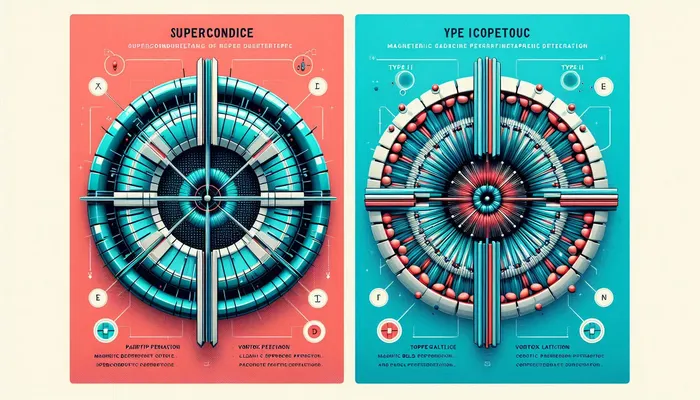
🧲 Type I and Type II Superconductors: A Scientific Overview
Superconductors are broadly classified into two distinct types based on their magnetic behavior and response to external fields: Type I and Type II. Understanding these categories is essential for both theoretical physics and real-world applications.
🔹 Type I Superconductors
Type I superconductors are generally pure elemental metals such as mercury (Hg), lead (Pb), and aluminum (Al). They exhibit a sharp transition into the superconducting state, characterized by:
- Zero electrical resistance
- Complete magnetic field expulsion (Meissner effect)
However, this superconducting state is maintained only below a single critical magnetic field . If the external field exceeds this threshold, superconductivity is entirely destroyed, and the material returns to the normal (resistive) state.
🔬 Key Characteristics:
- Critical field: One well-defined value ()
- Perfect diamagnetism up to
- Simple phase diagram
- Low critical temperature (), typically < 10 K
- Used primarily in theoretical studies, not practical for high-field applications
🔹 Type II Superconductors
Type II superconductors are usually metal alloys or ceramic-based materials like NbTi, YBCO, or Bi-2212. They are significantly more complex in behavior and structure but are far more useful for applications requiring high magnetic fields and current densities.
Instead of exhibiting an all-or-nothing response to magnetic fields, Type II superconductors allow partial penetration of magnetic flux through quantized vortices, resulting in a mixed state.
🧪 Two Critical Fields:
- Lower critical field : The field strength at which magnetic vortices begin to penetrate the material.
- Upper critical field : The field beyond which superconductivity is entirely destroyed.
🌪️ Mixed State:
In the region , the superconductor contains a lattice of magnetic vortices, each carrying a single quantum of flux:
Despite the magnetic field inside, electrical current still flows without resistance.
🔬 Key Characteristics:
- Two critical fields: and
- Mixed state allows higher field tolerance
- Common in high- materials
- Crucial in MRI, maglev, particle accelerators, quantum devices
📐 Classification Criterion: Ginzburg–Landau Parameter ()
The distinction between Type I and II superconductors is quantitatively defined using the Ginzburg–Landau parameter:
Where:
- is the London penetration depth
- is the coherence length
Interpretation:
- → Type I superconductor
- → Type II superconductor
This parameter essentially compares how deeply a magnetic field can penetrate to how coherent the superconducting state is over space.
📊 Summary Table: Type I vs Type II
| Property | Type I | Type II |
|---|---|---|
| Magnetic Field Expulsion | Complete (Meissner state) | Partial (Mixed state) |
| Critical Fields | Single | and |
| Flux Penetration | None | Vortex lattice |
| Materials | Pure metals | Alloys, ceramics |
| Application Use | Rarely used | Widely used in tech and industry |
| Critical Temperature Range | Typically < 10 K | Up to 135 K (in high- cuprates) |
| Ginzburg–Landau Parameter | \kappa < \frac{1}{\sqrt{2} | \kappa > \frac{1}{\sqrt{2} |
🧠 Conclusion
While Type I superconductors are simpler and foundational to theoretical models, Type II superconductors dominate in practical use. Their ability to sustain superconductivity under high fields and currents makes them central to modern applications in medicine, transportation, energy, and quantum computing.
🔮 What’s Next?
In Part 5, we’ll explore the thermodynamic nature of the superconducting phase transition. What happens to entropy, free energy, and specific heat when a material goes superconducting? Is the transition really second-order? Let’s find out. ion** in the universe’s quantum machinery.
🔔 Like what you’re learning? share, and follow to keep following this deep-dive into superconductivity!