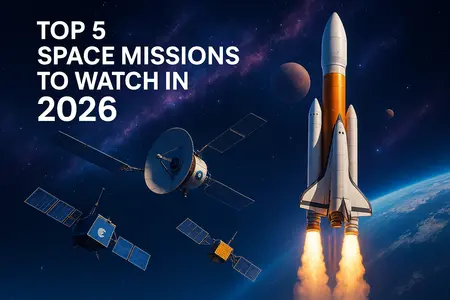
Space exploration is entering an exciting new era. Governments and private companies around the world are launching ambitious missions that could reshape our understanding of the universe and our place within it.
The year 2026 is expected to be particularly important for space science, with major missions planned by organizations like NASA, ISRO, and private aerospace companies. These missions range from testing human spacecraft to deploying advanced telescopes and satellites that will study distant galaxies, Earth’s environment, and the Moon.
What makes these missions even more exciting is the international collaboration and private-sector innovation driving modern space exploration. Countries are working together, while companies like SpaceX and Boeing are pushing technology forward faster than ever before.
In this article, we explore the top 5 space missions to watch in 2026, their goals, launch timelines, and the potential discoveries they may bring.
🚀 Top 5 Space Missions to Watch in 2026
1. Artemis II – NASA’s Crewed Return Toward the Moon

Agency: NASA
Expected Launch: 2026
Destination: Lunar flyby
The Artemis II mission is one of the most anticipated space missions of the decade. It will be the first crewed mission to travel toward the Moon since the Apollo program ended in 1972. :contentReference[oaicite:0]{index=0}
Mission Objectives
- Test the Space Launch System (SLS) rocket
- Evaluate the Orion spacecraft with astronauts onboard
- Perform a lunar flyby mission
- Test life-support, navigation, and deep-space communication systems
The mission will carry four astronauts, including members from NASA and the Canadian Space Agency.
Why It Matters
Artemis II is a critical step toward future Moon landings and long-term lunar exploration. The Artemis program ultimately aims to:
- Establish a sustainable human presence on the Moon
- Prepare astronauts for future missions to Mars
Fun Fact
The Orion spacecraft on Artemis II will travel farther from Earth than any human spacecraft since Apollo, reaching distances of nearly 370,000 km from Earth.
2. Gaganyaan-1 – India’s First Human Spaceflight Test

Agency: ISRO
Expected Launch: March 2026
Destination: Low Earth Orbit
India is preparing for a historic moment with Gaganyaan-1, the first uncrewed test flight of its human spaceflight program. :contentReference[oaicite:1]{index=1}
Mission Objectives
- Test the Gaganyaan crew module
- Evaluate life-support and environmental systems
- Demonstrate safe launch and re-entry technology
- Carry the humanoid robot Vyommitra to simulate astronaut conditions
The spacecraft will orbit Earth using the HLVM3 rocket and collect vital data for future human missions.
Why It Matters
If successful, the Gaganyaan program could make India the fourth country capable of independent human spaceflight, after the United States, Russia, and China.
Fun Fact
The mission will include experiments involving fruit flies, which scientists use to study how living organisms respond to microgravity. :contentReference[oaicite:2]{index=2}
3. Nancy Grace Roman Space Telescope – NASA’s Next Great Observatory

Agency: NASA
Expected Launch: October 2026
Destination: Sun–Earth L2 orbit
The Nancy Grace Roman Space Telescope is NASA’s next-generation space observatory, often described as the successor to the Hubble and complement to the James Webb Space Telescope.
Mission Objectives
- Study dark energy and the expansion of the universe
- Search for thousands of exoplanets
- Map billions of galaxies
- Detect near-Earth asteroids and planetary defense threats
The telescope will observe the universe with a field of view 100 times larger than Hubble, allowing scientists to survey vast regions of space quickly. :contentReference[oaicite:3]{index=3}
Why It Matters
Roman could revolutionize our understanding of:
- Dark energy
- Galaxy formation
- Planetary systems beyond our solar system
Fun Fact
Astronomers estimate Roman could discover over 100,000 new exoplanets during its mission.
4. Starliner-1 – Boeing’s Crewed Commercial Space Mission

Agency: NASA & Boeing
Expected Launch: 2026
Destination: International Space Station (ISS)
The Starliner-1 mission will be Boeing’s first operational crewed flight to the International Space Station.
It is part of NASA’s Commercial Crew Program, which partners with private companies to transport astronauts to and from space.
Mission Objectives
- Transport astronauts to the ISS
- Conduct orbital research missions
- Demonstrate reliable commercial crew transport
Why It Matters
This mission strengthens NASA’s strategy of working with private companies to reduce costs and increase the frequency of human spaceflight.
Private spacecraft like Starliner and SpaceX’s Crew Dragon are changing the future of space travel.
Fun Fact
The Starliner spacecraft is designed to be reusable up to 10 times, making missions more affordable.
5. PSLV-C62 Mission – Expanding Earth Observation

Agency: ISRO
Expected Launch: January 2026
Destination: Earth Orbit
Another exciting mission is PSLV-C62, which will launch multiple satellites including the EOS-N1 Earth observation satellite. :contentReference[oaicite:4]{index=4}
Mission Objectives
- Monitor Earth’s environment
- Improve space-based surveillance
- Launch international commercial satellites
The PSLV rocket will carry satellites from different countries, highlighting ISRO’s role as a global launch partner.
Why It Matters
Earth observation satellites help scientists track:
- Climate change
- Natural disasters
- Agricultural trends
- Environmental changes
These insights are critical for planning and disaster management.
Fun Fact
The PSLV rocket is often called ISRO’s “workhorse rocket” because of its high reliability and frequent launches.
Why 2026 Could Be a Turning Point in Space Exploration
The missions planned for 2026 represent a powerful mix of scientific discovery, international cooperation, and private innovation.
Some missions focus on human exploration, such as Artemis II and Gaganyaan-1. Others aim to deepen our understanding of the universe through advanced telescopes and satellites.
Together, these projects could lead to breakthroughs in:
- Planet discovery
- Climate monitoring
- Deep-space travel
- Human settlement beyond Earth
Most importantly, these missions inspire a new generation of scientists, engineers, and dreamers who will continue pushing the boundaries of exploration.
Space exploration has always captured the imagination of humanity. From the first satellite in orbit to astronauts walking on the Moon, each mission has brought us closer to understanding the universe.
The missions planned for 2026 show that the next chapter of space exploration is already unfolding. Nations like the United States and India are advancing human spaceflight, while powerful telescopes and Earth-observation satellites are expanding our scientific knowledge.
At the same time, private companies are transforming space into a collaborative and rapidly evolving frontier.
Whether it’s returning astronauts to the Moon, discovering new planets, or studying Earth from orbit, these missions remind us that the universe is still full of mysteries waiting to be explored.
Sources
- NASA Artemis II mission overview – Space.com :contentReference[oaicite:5]{index=5}
- Gaganyaan-1 mission details – Wikipedia :contentReference[oaicite:6]{index=6}
- ISRO upcoming missions and launch plans – Economic Times / NDTV :contentReference[oaicite:7]{index=7}
- PSLV-C62 Earth observation mission – Times of India :contentReference[oaicite:8]{index=8}
- Nancy Grace Roman Space Telescope science goals – NASA research paper :contentReference[oaicite:9]{index=9}